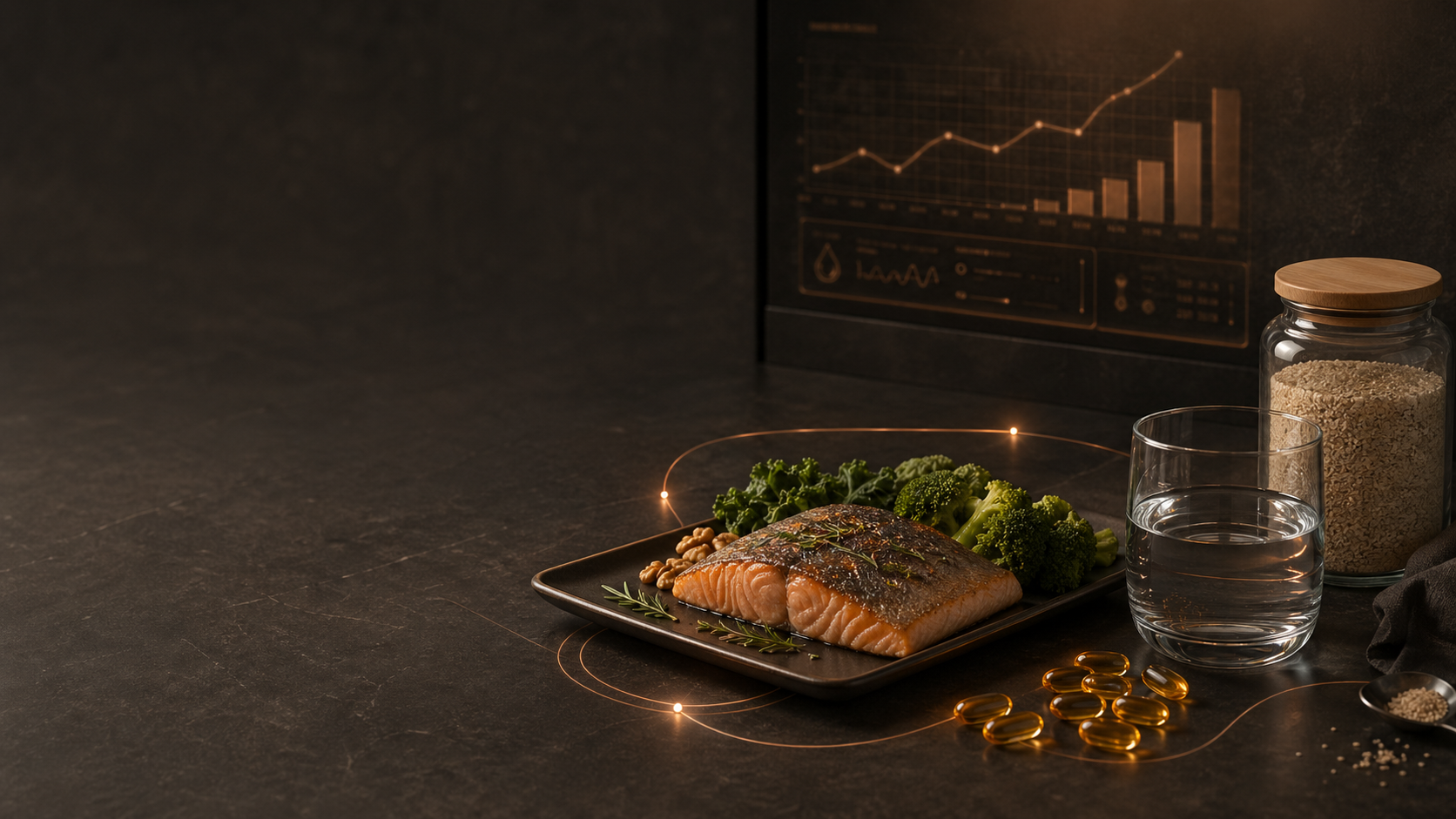
A low fatty-acid score turned fish and omega-3 into tracked habits.
Back to the Iron Map Personal Review / Preventive Health
FindingOmegaCheck 3.2% CaveatLDL-P 1279 ActionFiber, cardio, retest
Personal Review / Preventive HealthFunction Health found the bloodwork signals I could still change.
Function Health was valuable because it made prevention visible early. My standard markers were reassuring, but low omega-3 status and advanced LDL particle signals gave me specific targets: fish, omega-3, psyllium, structured Zone 2 and Zone 4 cardio, recovery tracking, retesting, and qualified medical follow-up.
The particle count became a clinician-review and retesting question.
Psyllium, Zone 2/4 structure, recovery tracking, and follow-up labs.
I did not sign up for Function Health because I felt broken. I lift, train, track recovery, and already had the kind of standard lab numbers that make a man feel like he is probably fine. That is exactly why the test was useful. I wanted to know what was quiet, measurable, and still early enough to change.
The headline numbers looked reassuring: LDL-C 98, HDL 67, triglycerides 63, ApoB in range, Lp(a) in range, and hs-CRP low. Then the deeper panel added the caveat: LDL particle number, small LDL, and medium LDL were above range; LDL peak size and large HDL were below range; and my OmegaCheck was low at 3.2%. Paired with HRV and recovery trends I was already seeing from wearable tracking, that was enough to change the plan before the story became dramatic.
For the marker-by-marker logic, the biomarker breakdown walks through ApoB, LDL-P, OmegaCheck, HbA1c, insulin, and the retesting question in more detail.
Biological age
12.9 years younger
strong
OmegaCheck
3.2%
low
LDL-P
1279 nmol/L
watch
hs-CRP
0.2 mg/L
calm
Triglycerides
63 mg/dL
strong

Boundary
Useful signals still need professional context.
This is a first-person Function Health review and prevention narrative, not diagnosis or treatment guidance. The lab values helped me decide what to discuss, retest, and change; medical interpretation still belongs with qualified professionals.
- Educational field notes, not medical advice.
- No clinician reviewed this page.
- Use qualified professionals for diagnosis, treatment, medication, supplement, and testing decisions.
What Happened
The value was not the size of the panel. It was the sequence: find, sort, act.
The panel gave me more information than a standard annual visit usually would. The AI layer helped organize it. The real test was whether any of it changed Monday morning: food, supplements, cardio structure, recovery, retesting, and clinician follow-up.


Best use
Earlier questions, not a dramatic diagnosis
Function Health made the most sense as a prevention tool: find quiet signals, decide what deserves attention, and bring better questions to a clinician.
What worked
The report turned vague goals into levers
Omega-3, fish, fiber, Zone 2, Zone 4, recovery tracking, retesting, and professional follow-up became specific enough to act on.
Watchout
More data can still create false confidence
A large panel is only useful if you resist panic, avoid self-diagnosis, and use the results as part of a broader risk picture.
Lab baselineHDL 67 / TG 63 / hs-CRP 0.2strong floor
The feedback loop
Function gave me the lab signal. Garmin made it a daily system.
This is where the review became personal: the labs were not the finish line. They were the starting point for a tighter routine built around omega-3, LDL particle context, sleep, HRV, and better cardio structure.
The first read looked strong.
Function Health did not hand me a crisis. The first useful insight was that several important markers were reassuring enough to keep the review honest.
Biomarker Context
The marker details mattered because they changed the next decision.
Function Health made the biomarkers visible. The second job was interpretation: the top-line numbers stayed reassuring, LDL-P became the lipid caveat, OmegaCheck became the clearest behavior lever, and HbA1c plus insulin kept the metabolic story grounded.
Markers That Changed The Plan
LDL-P1279 nmol/Lretest question
OmegaCheck3.2%behavior lever
ApoB81 mg/dLmeasured context
HbA1c / Insulin5.2% / 3.9metabolic baseline
The Setup
Traditional bloodwork might have told me I was fine.
If I had only looked at a normal cholesterol panel, I probably would have felt pretty good. HDL was solid, triglycerides were low, LDL was under 100, and the ratio looked clean. That is where a lot of people stop. Function Health kept going.
Standard Lipid Panel
The numbers looked clean at first pass.
| Marker | My Result | Read |
|---|---|---|
| Total Cholesterol | 180 mg/dL | Clean basic signal |
| HDL Cholesterol | 67 mg/dL | Strong |
| LDL Cholesterol | 98 mg/dL | Under 100 |
| Triglycerides | 63 mg/dL | Low |
| Non-HDL Cholesterol | 113 mg/dL | Reasonable |
| Total Cholesterol / HDL Ratio | 2.7 | Solid |
The Turn
The deeper panel told a different story.
My LDL-C was 98, which looks reasonable. But LDL particle number, small LDL, and medium LDL were above range, while HDL large and LDL peak size were below range. That is not a crisis. It is a better question.
The nuance mattered: ApoB, Lipoprotein(a), hs-CRP, and triglycerides were reassuring. The value was not fear. The value was knowing which result deserved follow-up instead of treating every number like an emergency.
Advanced Heart Markers
The hidden risk signals were in the particle data.
| Advanced Heart Marker | My Result | Function Flag |
|---|---|---|
| LDL Particle Number | 1279 nmol/L | Above range |
| LDL Small | 263 nmol/L | Above range |
| LDL Medium | 281 nmol/L | Above range |
| LDL Peak Size | 217.9 Angstrom | Below range |
| HDL Large | 5362 nmol/L | Below range |
| ApoB | 81 mg/dL | In range |
| Lipoprotein(a) | 23 nmol/L | In range |
| hs-CRP | 0.2 mg/L | In range |
The Most Actionable Finding
My omega-3 status was low enough to change behavior.
This was one of the most useful results in the report because I would not have known it from the mirror, the gym, or how I felt. A vague instruction to eat more fish is easy to ignore. A 3.2% OmegaCheck result is harder to ignore.
Personal behavior change
I started taking omega-3, made a more intentional effort to eat more fish, and gave the result a place in my follow-up plan.
OmegaCheck3.2% by weight
lowmoderatehigher
OmegaCheck
The fatty-acid panel created a clear target.
| Marker | My Result | Read |
|---|---|---|
| Omega-3 Total / OmegaCheck | 3.2% by weight | Below range |
| EPA | 0.3% by weight | Low signal |
| DHA | 1.8% by weight | Trackable |
| DPA | 1.1% by weight | Trackable |
| Omega-6 Total | 43.0% by weight | Context marker |
The AI Layer
AI helped separate signal from noise.
Large lab panels can make people overreact or underreact. One number scares you. Another gets ignored. For me, the useful role of AI was organization, not diagnosis. It made the pattern easier to see and the next questions easier to ask.
1
Standard lipids looked pretty good.
2
Inflammation was very low.
3
ApoB and Lipoprotein(a) were in range.
4
Glucose, insulin, and HbA1c were reassuring.
5
LDL particle markers were not perfect.
6
Omega-3 status was clearly low.
Why It Was Interesting
The metabolic context made the heart markers more useful.
These are not the numbers of someone obviously metabolically unhealthy. That is what made the advanced findings useful. This was not a simple "just stop eating junk" situation. It was a specific prevention question inside an otherwise strong routine.
Metabolic Markers
The baseline looked reassuring.
| Marker | My Result |
|---|---|
| Glucose | 95 mg/dL |
| HbA1c | 5.2% |
| Insulin | 3.9 uIU/mL |
| Triglycerides | 63 mg/dL |
Other Context
A lot of the report was good news.
Ferritin
92 ng/mL
Iron
132 mcg/dL
Iron Saturation
41%
Vitamin D
49 ng/mL
Zinc
90 mcg/dL
Homocysteine
8.8 umol/L
Total Testosterone
540 ng/dL
Free Testosterone
79.9 pg/mL
TSH
1.32
Free T4
1.3
Free T3
3.5
Prevention Became Action
The dashboard changed the next workout, the next grocery run, and the next test.
Function Health worked for me because it matched how I already think. I do not want to wait until the only options are dramatic measures or medicine to correct a problem that had been building for years. I want early signs, better odds, and gradual changes that can compound. In my case, that meant turning a vague goal like "improve heart health" into concrete levers: more omega-3, more fish, psyllium, Zone 2, Zone 4, recovery tracking, and retesting.
The cardio piece became its own learning curve after a Garmin run showed I had spent 70%+ of the session in Zone 5. I broke that down in the Zone 2 and Zone 4 training article.
The strength side of that same prevention loop is here: strength training after 40 as metabolic infrastructure. The labs gave me the signal, but muscle is one of the levers that makes the signal actionable.



Evidence Notes
What the sources actually support.
My panel is one case study, not a universal prescription. The sources below support the practical edges of the review: lipid risk refinement, fish and omega-3 intake, OmegaCheck test language, psyllium soluble fiber, and the need to keep health decisions clinician-aware.
FAQ
Function Health review questions, answered directly.
Is Function Health worth it if you already work out and feel healthy?+
For me, yes. The value was not that every result looked bad. The value was that advanced testing found low omega-3 status and lipid particle signals I likely would not have noticed from standard annual bloodwork alone.
What did Function Health find that a standard cholesterol panel might miss?+
My LDL-C was 98 mg/dL, triglycerides were 63 mg/dL, and HDL was 67 mg/dL, which looked reassuring. The deeper panel showed elevated LDL particle number, small LDL, and medium LDL, plus low large HDL and low LDL peak size.
Did the results mean something was seriously wrong?+
No. The useful point was nuance. Several important markers were reassuring, including ApoB, Lipoprotein(a), hs-CRP, triglycerides, insulin, and HbA1c. The takeaway was targeted prevention, not panic.
How did AI help with the lab report?+
AI helped organize the pattern: strong metabolic health, low inflammation, reassuring ApoB and Lipoprotein(a), but low omega-3 and imperfect lipid particle markers. It helped turn a large report into a clearer action plan, but it did not replace a doctor.
What changes came from the Function Health results?+
The results pushed me to take omega-3 more seriously, eat more fish, buy psyllium husk, add more structured Zone 2 cardio, keep targeted Zone 4 work in the mix, and plan follow-up testing.
Can you export Function Health results?+
Yes. Function says members can download and share results, and its FAQ says ready results can be downloaded as a PDF to share with a healthcare provider. The practical path is to log into Function, open the documents or results area, download the lab-results PDF, and bring or send it to your clinician. Use the export to ask better questions, not to self-diagnose.
Is this medical advice?+
No. This is personal experience and educational analysis. Lab results should be reviewed with a qualified healthcare professional, especially when they involve cardiovascular risk, hormones, nutrient status, or clinically meaningful markers.
Important Note
My Function Health review is based on personal experience and is not medical advice. Lab results should be reviewed with a qualified healthcare professional, especially when they involve cholesterol, cardiovascular risk, inflammation, hormones, nutrient status, or other clinically meaningful markers. AI can help organize and explain information, but it should not replace professional medical judgment.