The Apple announcement · September 2026
Apple Watch, HRV, and the decision after the number.
The Series 12 and Ultra 4 put recovery, VO₂ max, and long-term health at the center of Apple’s pitch. Here is what changes—and how it fits the system we already use.
· 14 min read
Analysis of announced features, checked September 11, 2026. We have not tested Series 12, Ultra 4, or the forthcoming Health app. Educational reporting; no clinician reviewed this article. Our editorial standards.
01 / The editorial stakes
The watch is becoming an interpreter.
A watch can count the work without helping you decide whether to do it. That gap is the reason this announcement belongs on Iron & Threads. Our interest starts with the morning after a broken night, the run that keeps drifting too hard, and the lab result that needs a useful next step. A better dashboard earns its place when it makes one of those situations easier to handle.
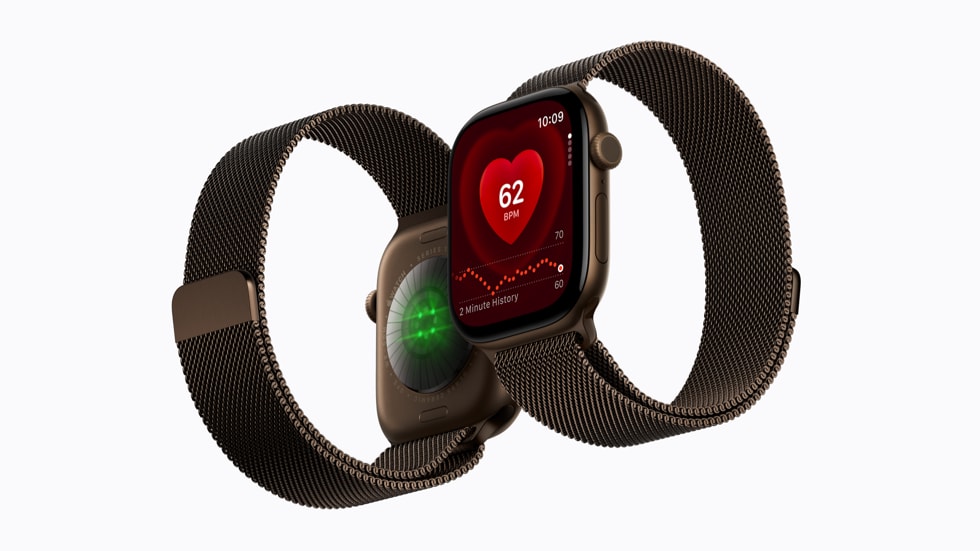
Apple’s September 9 launch links new watch sensing with a larger health experience. Series 12 and Ultra 4 are the new hardware. The more ambitious interpretation layer arrives through a redesigned Health app later this year. Those are related releases with different availability, and they deserve separate judgments.
HRV and VO₂ max are not new to Apple. The company was promoting cardio-fitness notifications and the connection between fitness and long-term health in December 2020. Its established developer documentation also defines an HRV measure. Calling this the moment Apple discovered recovery or longevity would get the history wrong.
Iron & Threads already had dedicated HRV and VO₂ max guides dated June 9 and June 10, 2026, before this September announcement. Our earlier coverage connects those signals to training, bloodwork, and the constraints of real life. That is the continuity worth claiming: we have already been working through the questions Apple now puts more prominently in front of its customers.
The test for this generation is whether interpretation helps people sustain useful habits. It is also whether a confident score makes the limits of the underlying evidence easier to overlook. Both possibilities belong in the same feature.
02 / The launch ledger
What changes, and what it changes for the reader.
| Feature | Apple’s promise | The Iron question |
|---|---|---|
| Heart rate | A reading every five seconds throughout the day on the new sensing system. Series 12. | Does the watch capture the situations that used to leave gaps? |
| HRV | As often as every five minutes, with Recovery and overall views. Ultra 4. | Can you identify a useful change from your own baseline? |
| Readiness | A 0–10 score, updated during the day, using activity, training load, vitals and sleep score. Series 12. | Does the explanation improve the day’s plan? |
| Vitals | Recovery HRV joins the overnight view; a daytime view adds context. Series 12. | What changed, over what window, and under what conditions? |
| Later Health app | Health Age, movement assessments and U.S. lab purchasing. Apple Health. | Which outputs are estimates, which are clinical results, and what follow-up do they support? |
03 / Recovery
More HRV readings need a better baseline.
HRV concerns variation in the intervals between beats. It is a different question from heart rate: two recordings can have the same average beats per minute while differing in beat-to-beat timing. And different HRV statistics summarize that variation differently. The ESC/NASPE measurement standards define those statistics and explain why recording duration affects comparability.
Apple’s existing SDNN field uses the standard deviation of normal-to-normal intervals. Its version-27 developer documentation introduces a separate RMSSD field. RMSSD is the root mean square of successive differences between usable normal-to-normal intervals. The launch materials we checked do not explicitly map the consumer labels Recovery HRV and overall HRV to those two formulas. That mapping should be documented before anyone treats a new displayed number as interchangeable with an old one.
This is the practical problem with a screenshot that simply says “my HRV is 45.” Which statistic? Which part of the day? How long was the recording? Was it taken while resting, breathing deliberately, or sleeping? Without that information, the comparison may be between different quantities sharing the same unit.
Apple’s five-minute wording also needs to survive the retelling. “As often as” describes an upper cadence, not a guarantee of a valid reading every five minutes. More opportunities could help fill gaps. They do not, by themselves, show that each interval is accurate or that the finished daily summary will be more useful.
A 2024 validation study compared Series 9 and Ultra 2 with a Polar H10 reference across 316 paired morning recordings from 39 healthy adults. The SDNN measurements did not meet the study’s predefined equivalence margin. That is older-device evidence under controlled conditions, not an error estimate for Series 12. It shows why “the heart-rate sensor is accurate” cannot stand in for validation of a particular HRV output.
Our HRV guide uses Garmin’s own baseline and status system. Those Garmin-specific time windows should not be copied onto Apple. The transferable habit is to compare like with like on the same device and measure, then read the change alongside sleep, recent exertion and how you actually feel. A new watch or a changed algorithm deserves a fresh reference period, rather than a dramatic before-and-after claim.
04 / The evidence
Apple supplied a heart-rate study. Read its boundaries.
Apple’s September accuracy paper enrolled 1,460 participants; 1,254 contributed paired data to the analysis. It tested Series 12 against other wearables using a Polar H10 ECG chest strap as the reference during workouts and daily activities. Apple reports lower overall heart-rate error under that protocol. This is manufacturer research, not independent replication.
Its exclusions included beta-blockers, unstable cardiovascular conditions and tattoos or large moles at device sites. The result is specific to the tested protocol. It does not establish HRV accuracy or validate Health Age, Readiness or health outcomes.
For data exporters, the paper describes five-second user-facing heart-rate values but background writes to HealthKit every 30 seconds. Do not expect the export to reproduce every number shown on the watch.
This is where a product launch needs several separate questions. Does the sensor agree with a reference? Does the calculation preserve useful information? Does the recommendation help the intended person? Success at the first step gives the next steps a better input. It does not answer them.
05 / Capacity
VO₂ max matters. The way it is obtained matters too.
VO₂ max describes maximal oxygen consumption during exercise. Apple’s established Cardio Fitness feature estimates it from heart and motion data during qualifying outdoor walks, runs and hikes. Profile information—including weight and medications affecting heart rate—also enters the estimate. Apple’s current support guidance says indoor workouts do not count toward that existing workflow.
Fitness earns this attention because it relates to outcomes beyond a race time. An observational study of 4,137 adults used directly measured fitness and found an inverse association with mortality over long follow-up. That supports taking cardiorespiratory fitness seriously. It does not show that increasing a watch estimate by a particular amount adds a predictable number of years to someone’s life.
The announced Movement Evaluation is a separate, forthcoming route. Apple describes assessments using an iPhone camera, and its footnote specifically calls the VO₂ result an estimate requiring Apple Watch, AirPods Pro 3 or a third-party heart-rate device. It is not a camera measuring oxygen uptake. Apple’s feature requirements. A laboratory exercise test measures respiratory gases with appropriate equipment; the result is obtained in a materially different way.
The distinction is not an argument against an estimate. An accessible, repeatable estimate can still help someone notice a trend. But convenience cannot establish its agreement with a laboratory test, and an older validation study cannot certify a future camera-assisted protocol.
There is independent evidence for keeping that boundary visible. In a 2025 PLOS One study, 28 participants met the maximal treadmill-test criteria. Their older Apple Watch estimates averaged 6.07 mL/kg/min below the laboratory result, with substantial individual variation. The sample was small and mostly highly fit, and it combined several models. Do not add 6.07 to your watch or apply that result to the new hardware: it is evidence about that study’s method and population.
For an Iron reader, the question is whether the trend lines up with the work. Are comparable sessions becoming easier? Can you sustain your usual route with less effort? Is your training repeatable across an ordinary month? Our VO₂ max guide and training field report use the watch as part of that conversation, alongside what actually happens on the road.
Apple also documents that software can offer to revise earlier Cardio Fitness estimates. That is a reason to note device and software changes in your own records. A sudden dashboard improvement can reflect a changed estimate, not a week of extraordinary adaptation. Apple Support. Keep the circumstances attached to the number.
06 / The morning decision
A readiness score should open the explanation.
Apple presents Readiness with four labels: Recover, Pace Yourself, Ready and Go For It. The score can change as the day develops, and the interface exposes its contributing factors. Apple’s product page frames it as a way to decide how to approach the day. That is appealing precisely because most people do not want to interpret four separate charts before breakfast. Apple has not published the scoring formula or factor weights in the launch materials.
The risk is that the summary becomes more authoritative than its ingredients. A low score after a demanding day might be a useful prompt to look at the details. A high score does not know every constraint in your calendar, and it does not provide medical clearance for hard exercise. An injury, symptoms, a clinician’s advice, and your own experience do not disappear because the watch is optimistic.
The decision we want is modest: can this information make a sensible plan more adaptable? For the tired parent, an explanation that points to disrupted sleep can be more valuable than another reminder to be disciplined. Our fitness systems for busy fathers article starts with that constraint. It asks what a sustainable version of the day looks like, rather than assuming every day should be a personal best.
The other metrics are part of the story
Sleep score and training load already existed. Apple introduced Vitals and training load with watchOS 11 in 2024; sleep scoring followed in the 2025 generation. The current announcement changes how those inputs are connected. Reporting every familiar input as a newly invented feature would obscure what is actually new.
Resting heart rate is another useful companion to the recovery conversation, and it has its own Iron guide. Keep the resting trend separate from a momentary heart-rate reading. Sleep duration and consistency, breathing and temperature information, and recent training provide context; they should not be collapsed into the idea that one metric tells the whole story. Apple’s health overview identifies respiratory rate and wrist temperature among the Vitals inputs.
Existing heart and sleep notifications also remain distinct from wellness scoring. For example, Apple’s 2025 hypertension announcement describes pattern detection, not a watch displaying a cuff-style blood-pressure reading. The new Vitals features are explicitly for wellness use. A change in an app can justify asking a question; it is not itself a diagnosis.
07 / The long view
Health Age makes a complicated story feel simple.
Apple’s coming Longevity view can use VO₂ max, resting heart rate, sleep and HRV, with added lab results such as A1c and LDL. Health Age compares selected metrics with chronological age. Apple’s health announcement describes the ingredients, but does not publish a complete formula, uncertainty range or outcome validation for the finished score.
That distinction belongs next to any number expressed in years. An age-relative score is a way of presenting a model. It is not a measurement of how many years remain in your life, and a younger score is not evidence that you reversed biological aging. Before putting much weight on it, we would want to understand the reference population, the handling of missing data and what a change in the score actually predicts.
The best version would make the underlying factors easier to see. A reader could notice a long-term change, learn which inputs contributed and bring an appropriate question to a professional. The weak version would turn the composite into a competition while the individual results receive less attention. A favorable age label should not make a concerning lab result feel unimportant.
The bloodwork still comes from bloodwork
Apple announced a separate $119 Quest panel with more than 50 biomarkers at about 2,000 U.S. locations. Launch details. This is a lab-purchasing workflow; the watch does not measure cholesterol or A1c at the wrist. Importing a result, commissioning a blood test and measuring a pulse remain different operations.
Our Function Health review, lab export guide and biomarker explainer already put those operations in context. The value of a panel depends on the question, the assays, the interpretation and the follow-up. A biomarker count and a launch price cannot establish that two services offer equivalent testing or care.
The announced flexibility, balance, strength and movement-mechanics assessments widen the story beyond cardio. That fits our strength and metabolic-health coverage: a useful health framework should have room for physical function. We will judge the new assessments on their protocols, repeatability and appropriate use once those details are available, rather than treating an on-screen evaluation as a comprehensive examination.
08 / Before an upgrade
Three release dates are hiding inside one announcement.
| Release | Timing and cost | What to check |
|---|---|---|
| watchOS 27 | September 14. Apple release. | The listed Watch families are Series 9 or later, SE 3, and Ultra 2 or later. OS support does not establish new-sensor feature support. |
| Series 12 / Ultra 4 | September 18; U.S. starting prices $399 / $799. Series 12; Ultra 4. | Apple ties the new sensing system and Readiness to these models. |
| Redesigned Health app | Later in 2026, starting in U.S. English. Product details. | Requires an Apple Intelligence-capable iPhone or iPad; some functions are iPhone-only. Health Age requires Apple Watch. Feature and regional limits apply. |
An older-watch owner should check each desired feature separately. General watchOS compatibility, a phone’s Apple Intelligence eligibility and a new sensor requirement are three different tests. The announcement does not justify assuming every supported older watch receives every new recovery feature.
There is even an inconsistency in the launch copy: the watch releases list iPhone SE second generation or later, while the health release lists SE third generation for watchOS pairing. Owners of an SE should verify Apple’s final support documentation rather than buy on that ambiguous line. The redesigned Health app has its own stricter Apple Intelligence requirement.
Ultra 4’s separate attraction is endurance: Apple advertises up to 50 hours of normal use and 84 in Low Power Mode. Those are test-based manufacturer claims, with results varying by use. Ultra 4 specifications. For this readership, comfort and enough battery to wear the device through the night deserve weight alongside extra features. A sensor cannot observe a night spent on a charger.
Our present buying judgment is to wait for reviews of the exact feature that would justify replacing your watch. A working recovery-and-training routine does not become obsolete on announcement day. And paying more for the Ultra does not turn a shared wellness score into stronger clinical evidence.
09 / Our framework
Keep three questions separate.
The framework below is our editorial way of using the information, not Apple’s scoring algorithm or a medical protocol. It separates the question about today from the question about months of training, and both from the question that belongs in a clinical conversation.
| Question | Evidence to put beside it | Useful next step |
|---|---|---|
| How am I doing today? | A consistent personal HRV measure, sleep, resting trends, recent workload and how you feel. | Review the explanation before changing the plan. A single surprising value earns a check, not a diagnosis. |
| Is the training building capacity? | Comparable workouts, pace and effort, VO₂ estimates, recovery and the routine across weeks. | Look for agreement across the record. Check inputs and software changes when one number suddenly diverges. |
| What needs medical context? | Symptoms, history, properly obtained lab results and clinically relevant measurements. | Bring the question and the actual data to an appropriate professional. A dashboard summary cannot clear a medical concern. |
Consider an illustrative Monday: the watch looks favorable, but the night was short and the planned workout conflicts with a demanding day. The score is information for that decision; it does not own the decision. Equally, one unfavorable morning need not erase a month of steady work. Look at the inputs, adjust proportionately and keep the longer record intact.
Now consider a different situation: the VO₂ estimate rises sharply after a software change while familiar workouts feel the same. That calls for checking the measurement history before celebrating a physiological breakthrough. If both the estimate and comparable exercise performance improve over time, the interpretation becomes more persuasive. Agreement across imperfect signals can be more useful than intense attention to one of them.
This is also why switching platforms deserves care. Our Garmin review describes an established experience, and our zone setup guide deals with getting its inputs right. It is not a controlled comparison with the unreleased Apple watches. A different number after switching devices may reflect different measurement and scoring methods. Preserve the old record and build context for the new one.
For the buying decision, read our Apple Watch Ultra 4 vs Garmin fēnix 9 Pro comparison. For the watch already on my wrist, the separate Ultra 4 vs my epix Pro (Gen 2) analysis asks what would actually justify switching. Both connect the hardware choice to the HRV, fitness, and training framework here.
10 / The editorial verdict
The opportunity is a better habit, not another score to obey.
Apple’s direction is relevant to this site because it brings measurement and interpretation closer together. A reader who has never opened an HRV chart may soon encounter recovery context in the normal course of using a watch. Someone focused only on exercise may see a reason to consider sleep, function and clinical data in the same broader picture.
The evidence still has to catch up to the full promise. Our recommendation would depend on readable explanations, reliable data capture in ordinary use, well-documented changes to the metrics, and validation matched to each actual feature. We also want the system to remain useful when the week is messy, the data is incomplete, or the reader has a good reason to question the suggestion.
For existing Iron readers, this is a reason to sharpen the framework already in use. Learn what the number represents. Keep its context. Decide what deserves action and what needs more observation. Apple can make that process easier to access. The value will show up in the decisions people can sustain after the novelty wears off.
Sources & reporting notes
This feature compares Apple’s September 9 releases, product pages, developer documentation and technical study with existing measurement guidance and original research. Sources were checked September 11, 2026. Manufacturer specifications are promises, our decision framework is editorial analysis, and earlier-device validation is identified as such. We do not assign a product score, claim hands-on testing, count keynote mentions, or treat unannounced software details as confirmed. The article contains no paid Apple purchase links.
- Introducing Apple Watch Series 12, with the all-new Health Sensing SystemApple Newsroom · September 9, 2026
Manufacturer announcement: sensor system, Readiness inputs, launch timing and footnotes.
- Apple unveils Apple Watch Ultra 4Apple Newsroom · September 9, 2026
Manufacturer announcement: shared health features, battery claims and U.S. starting price.
- Apple advances health and fitness capabilities using Apple IntelligenceApple Newsroom · September 9, 2026
Future Health app, Movement Evaluations, Health Age, Quest labs and feature-specific dependencies.
- Apple Watch Series 12Apple · Accessed September 11, 2026
Product specification and feature presentation. Marketing claims are attributed to Apple.
- Apple Watch Heart Rate Accuracy StudyApple · September 2026
Manufacturer study; pages 3–6 describe enrollment, exclusions, data cadence and results. Not a validation of the new health scores.
- heartRateVariabilitySDNNApple Developer Documentation · Accessed September 11, 2026
Definition of Apple’s established SDNN quantity.
- heartRateVariabilityRMSSDApple Developer Documentation · Accessed September 11, 2026
Separate RMSSD quantity in the version-27 platforms; does not establish its consumer-label mapping.
- Track your cardio fitness levelsApple Support · October 27, 2025; accessed September 11, 2026
Existing outdoor Cardio Fitness estimation, required inputs and medication caveats.
- Cardio fitness notifications are available today on Apple WatchApple Newsroom · December 14, 2020
Historical evidence that Apple’s VO₂ max and long-term-health positioning predates this launch.
- watchOS 11 is available todayApple Newsroom · September 16, 2024
Historical introduction of Vitals and training load.
- Apple debuts Apple Watch Series 11, featuring groundbreaking health insightsApple Newsroom · September 9, 2025
Historical sleep score and hypertension notification announcement.
- Heart rate variability: standards of measurement, physiological interpretation and clinical useESC / NASPE Task Force · Circulation · March 1996
Foundational definitions of SDNN and RMSSD; the recording window matters when comparing values.
- The Validity of Apple Watch Series 9 and Ultra 2 for Serial Measurements of Heart Rate Variability and Resting Heart RateO’Grady and colleagues · Sensors · September 26, 2024
Controlled older-model validation with 39 adults and 316 paired observations; does not test Series 12 or Ultra 4.
- Investigating the accuracy of Apple Watch VO₂ max measurements: A validation studyLambe and colleagues · PLOS One · May 15, 2025
Small, mostly high-fitness sample; 28 participants met maximal-test criteria. Older hardware and software, not the announced Movement Evaluation.
- Cardiorespiratory Fitness and Mortality in Healthy Men and WomenImboden and colleagues · Journal of the American College of Cardiology · November 6, 2018
Observational cohort using directly measured fitness. Supports population associations, not personal lifespan predictions.
- Apple HealthApple · Accessed September 11, 2026
Context for Vitals, respiratory rate, wrist temperature and existing health features.
- 2024 American Heart Association and American Red Cross Guidelines for First AidAmerican Heart Association / American Red Cross · 2024
Emergency assessment guidance; a wellness score must not delay appropriate care.
- Syncope (Fainting)American Heart Association · Accessed September 11, 2026
Medical evaluation of fainting.
Corrections should identify the claim and its supporting source. See our correction standards and health boundaries.
Put the announcement to work